
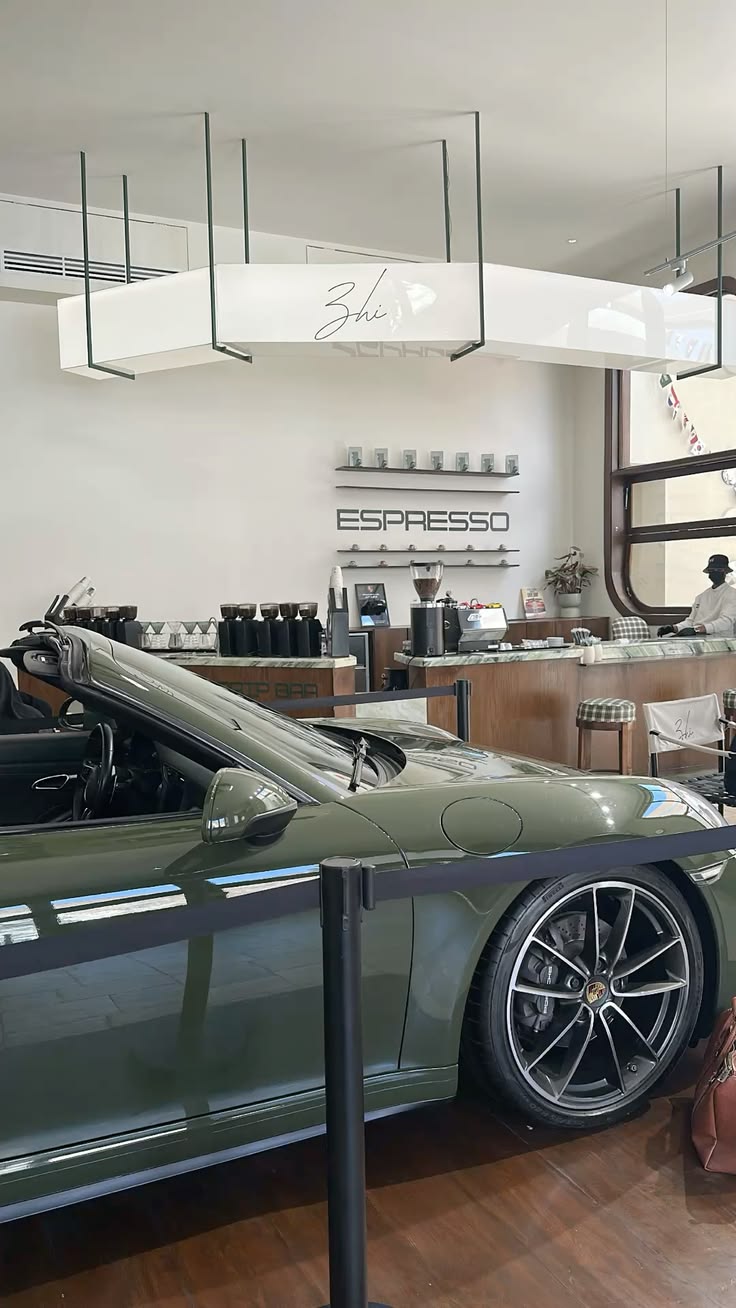
DUBAI RUNS ON COFFEE AND HORSEPOWER
Dubai has never treated cars as simply a way of getting from one place to another. Here, what you drive can be an expression of design, engineering, nostalgia, performance or personality. On any given morning, a pristine classic might be waiting at the lights beside a modern supercar, while a carefully restored 4x4 can attract just as much attention as something considerably newer and faster. But increasingly, Dubai’s automotive culture isn’t only happening on the road. It is unfolding over coffee.
Across the city, a growing number of cafés and automotive spaces are bringing together two cultures that, at first glance, might seem unrelated: specialty coffee and cars. Look a little closer, however, and the relationship makes perfect sense. Both attract people who care deeply about details. Both have their own rituals, terminology and communities. Both inspire remarkable levels of enthusiasm. And both have become ways for people to connect around a shared interest.
The result is a distinctly Dubai kind of social space — somewhere between a café, a clubhouse, a garage and a gallery. At these places, the parking lot can be just as interesting as the interiors. You might arrive for an espresso and find yourself walking around a beautifully restored classic parked outside. Someone else arrives in something completely unexpected, a conversation begins, and suddenly what was meant to be a quick coffee becomes an afternoon spent discussing design, engineering, restoration and everything on four wheels.
That spontaneity is part of what makes the culture so interesting. Traditional car meets are usually organised around a specific date, location or community. Car cafés create something looser. The gathering can happen organically simply because the right combination of people arrives at the same place. One morning might bring together vintage European cars, while another could see Japanese performance models, off-road builds, motorcycles and contemporary supercars sharing the same parking lot.
Dubai is particularly suited to this kind of culture. Its roads bring together vehicles and automotive influences from around the world. There are collectors interested in historically significant cars, enthusiasts obsessed with modifications and engineering, drivers drawn to motorsport and others who simply appreciate good design. The city’s international population adds another layer, bringing together British classics, American muscle, German engineering, Japanese tuning culture, Italian exotics and increasingly collectible cars from the 1980s, 1990s and early 2000s.
Put all of those influences together and Dubai becomes less of a single car scene and more of a meeting point between many different ones. The café provides neutral ground. You don’t necessarily need to own a rare car to participate, nor do you need to know every engine code, production year or technical specification. You can simply appreciate what you see, ask questions and join the conversation. Because some of the most interesting aspects of car culture have very little to do with ownership. Sometimes, enthusiasm is enough.
There is also something particularly natural about pairing cars with coffee. Dubai’s specialty coffee scene has developed its own passionate audience, with people increasingly interested in beans, origins, roasting styles and brewing methods. In many ways, the mindset isn’t far removed from automotive culture. Precision matters. Craft matters. Details matter. There is an appreciation for process and an almost ritualistic quality to both.
There is a practical reason the pairing works too: coffee gives people a reason to stop. Car culture naturally revolves around movement — driving, racing, cruising and touring. A café changes the rhythm. It gives people somewhere to park, sit and actually talk. And those conversations are ultimately what turn a collection of cars into a community.
The spaces themselves have evolved alongside that community. The traditional garage was once almost entirely functional: somewhere to repair, maintain or store a vehicle. Today, those boundaries are increasingly blurred. A garage can also become a showroom, a workshop can double as a creative space, a private collection can resemble a gallery and a café can exist somewhere between all three.
Industrial architecture works particularly well in this world. Concrete floors, exposed structures, workshop equipment and cars displayed almost as pieces of art create an environment that feels authentic rather than overly polished. There is a certain pleasure in drinking coffee only a few metres away from a machine someone may have spent years restoring.
It also changes the way cars are experienced. In a conventional showroom, vehicles are usually presented as products. Within enthusiast spaces, the relationship becomes more personal. A scratch might have a story behind it. A faded badge may have deliberately been preserved. An older car doesn’t necessarily need to look new to be valuable. The conversation moves away from price and towards provenance, engineering, restoration, memories and the reasons people become emotionally attached to machines in the first place.
Perhaps most importantly, these spaces have become modern meeting points. People return because they recognise familiar faces. Friendships form, weekend drives are organised, recommendations are exchanged and communities develop beyond the physical café. Someone knows the right mechanic. Someone else knows where to source an impossible-to-find part. Another person has a restoration project they have been working on for years.
That sense of community is what separates an authentic automotive destination from somewhere that has simply adopted the aesthetic. Putting car memorabilia on a wall can create a theme. Creating somewhere enthusiasts genuinely want to spend time is different. The strongest spaces feel less like businesses built around cars and more like communities that happen to serve very good coffee.
And despite Dubai’s international reputation for supercars, the city’s wider automotive culture is far more diverse. A beautifully preserved everyday car from the 1980s can generate more conversation among the right crowd than the newest hypercar. An old Land Cruiser carrying decades of history can be just as compelling as something engineered to reach extraordinary speeds. A meticulously restored classic tells a different story from a heavily modified performance car, but both reveal the same thing: somebody cared enough about that machine to preserve, change or perfect it.
These spaces allow those different worlds to cross paths. Someone interested in contemporary performance might unexpectedly find themselves discussing analogue driving with a classic-car owner. A person who arrives because they love Porsche might leave fascinated by an obscure Japanese model they had never properly noticed before. Generations mix too. For one visitor, a particular car might represent nostalgia; for someone younger, it could be a machine they have only ever encountered online.
Cars also make sense in these lifestyle environments because, beyond their mechanical purpose, they are extraordinary pieces of industrial design. Look beyond horsepower and consider the proportions, materials, typography of an old dashboard, simplicity of a vintage interior or dramatic difference between analogue cabins and the screen-filled vehicles being produced today. Cars document changing ideas about technology, luxury, performance and beauty.
That makes automotive cafés relevant beyond traditional enthusiast circles. They can attract photographers, designers, architects and creatives who may be just as interested in the silhouette of a car as the engine beneath its bonnet. Automotive culture increasingly overlaps with fashion, art, hospitality, watches, photography and design, and Dubai is particularly receptive to those crossovers.
There is something equally appealing about the weekend ritual surrounding these places. During the cooler months, before brunch reservations and shopping malls fill up, Dubai has a quieter morning window when enthusiasts can take out cars that may spend much of the working week under covers. There doesn’t necessarily need to be an organised event. Drive somewhere, park, order a coffee and see who else appears.
In a city defined by movement, schedules and constant development, there is something refreshingly uncomplicated about that ritual. It is simply a place to spend time around people who are interested in the same things you are.
Ultimately, that may be the reason Dubai’s car café culture feels like more than another hospitality trend. The appeal isn’t really just about the cars, and it isn’t only about the coffee. It is about what happens when the two give people a reason to gather.
You can arrive knowing exactly what you’re looking at or knowing almost nothing. You can spend ten minutes grabbing a coffee or lose an afternoon talking to someone about a car you never expected to care about. Dubai already had the machines and it already had the coffee culture. What these spaces have created is somewhere for the people behind both worlds to meet.
So the next time you head out for coffee, pay attention to what is parked outside.
You might stay longer than expected.
Come for the coffee. Stay for what pulls into the parking lot.
Follow @djournal_magazine for more stories at the intersection of lifestyle, design and culture.