
Hermès at Milan Design Week 2026
At Milan Design Week 2026, where spectacle often vies for attention, Hermès takes a quieter, more assured route. Its presentation unfolds not as a display but as a measured composition — one that privileges rhythm over revelation, and material over message.
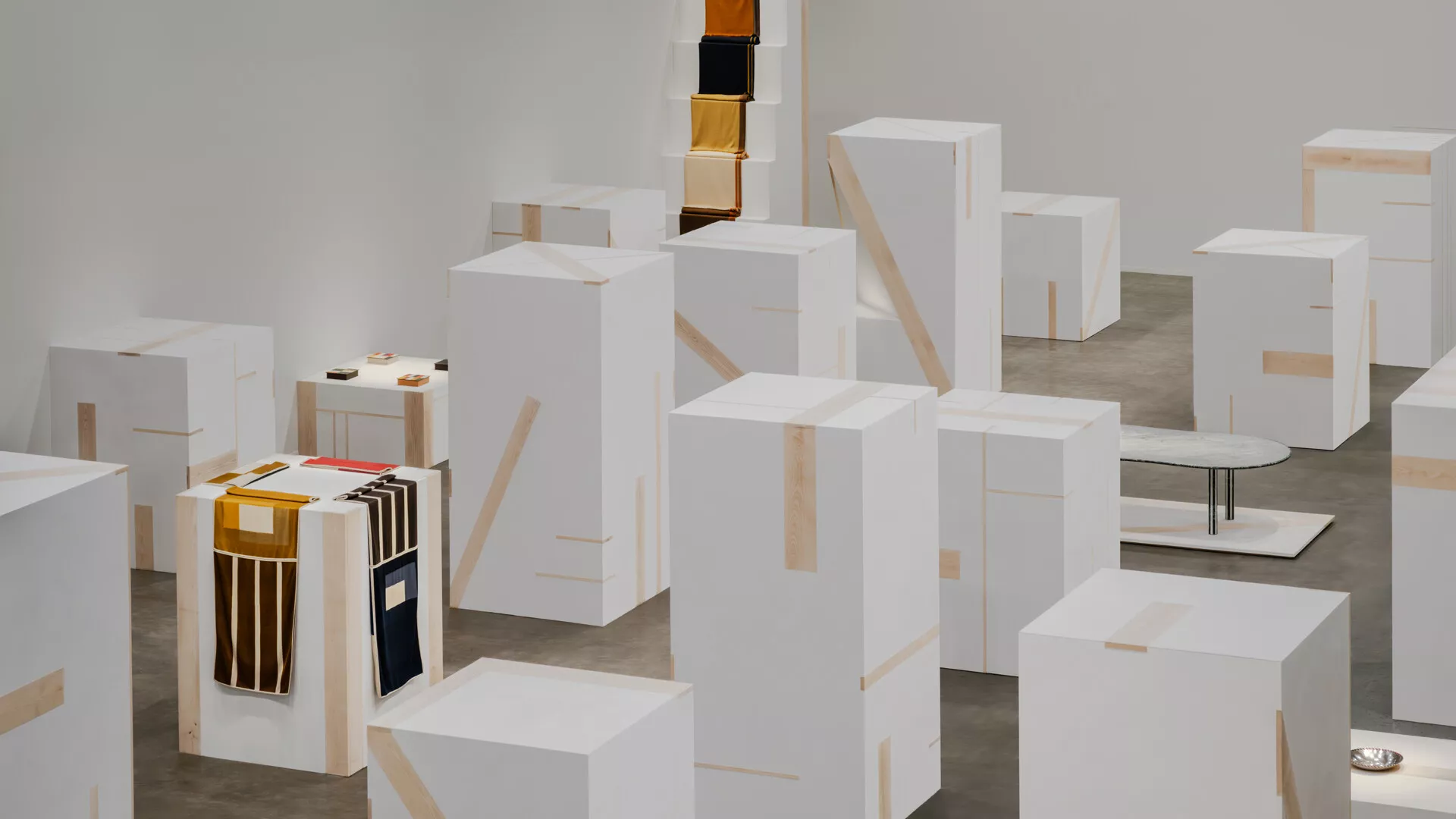
Conceived by Charlotte Macaux Perelman and Alexis Fabry, the house’s home universe is reimagined as a landscape of thirty columns, rising from 80 centimetres to three metres. Crafted in beechwood and plaster, these rectilinear forms establish a cadence: an architectural procession that draws the visitor inward. There is a deliberateness to the spacing, to the alternation of void and volume, that recalls the artisan’s repeated gesture — patient, exacting, infinite in its variation.
Objects appear almost incidentally along this path. A table — the Stadium d’Hermès, designed by Edward Barber and Jay Osgerby — curves in a figure-of-eight, its marble marquetry echoing the oval of a racetrack or the arc of a horse’s back. Carrara’s pale veining meets the saturated green of Verde Alpi, edged with a precision that suggests the polished borders of leather. It is at once grounded and improbably light, a study in equilibrium.
Elsewhere, the Palladion line explores the tension between strength and ornament. Hammered metal — finished in palladium — catches and scatters light with a silversmith’s sensitivity, its surface alive with minute irregularities. A jug extends into a cassia wood handle; a centrepiece recalls a shield; vases are sheathed in horsehair and leather, their silhouettes softened, then sharpened again by contrast. The dialogue is elemental: light against shadow, metal against hide.
This interplay continues in the smaller gestures. Boxes in leather marquetry, their surfaces composed like piano keys, shift from bursts of vermilion to near-monochrome restraint. Baskets punctuated with confetti-like appliqués conceal, almost mischievously, the outline of an H. Even the most decorative elements retain a sense of discipline — colour deployed not as flourish but as punctuation.
Textiles, as ever, anchor the collection. Hand-woven in Nepal, the cashmere throws speak to Hermès’ enduring reverence for time-intensive craft. Resist-dyed panels reveal geometric compositions that seem to hover between opacity and light; bojagi-inspired constructions, stitched with coloured silk thread, form barely-there seams that read like lines of breath. Each piece is a quiet accumulation of hours — and of intent.
What emerges, ultimately, is not a singular object but a way of seeing. The installation resists the immediacy of contemporary design fairs, favouring instead a slower encounter — one in which movement, perspective and materiality are inseparable. The visitor does not simply observe; he wanders, measures, aligns.
In this measured wandering, a kind of city takes shape — not literal, but imagined. Columns become streets, objects become markers, colour becomes atmosphere. And as the light shifts across marble, metal and fibre, Hermès offers a reminder that luxury, at its most compelling, is not declared. It is discovered — step by considered step.